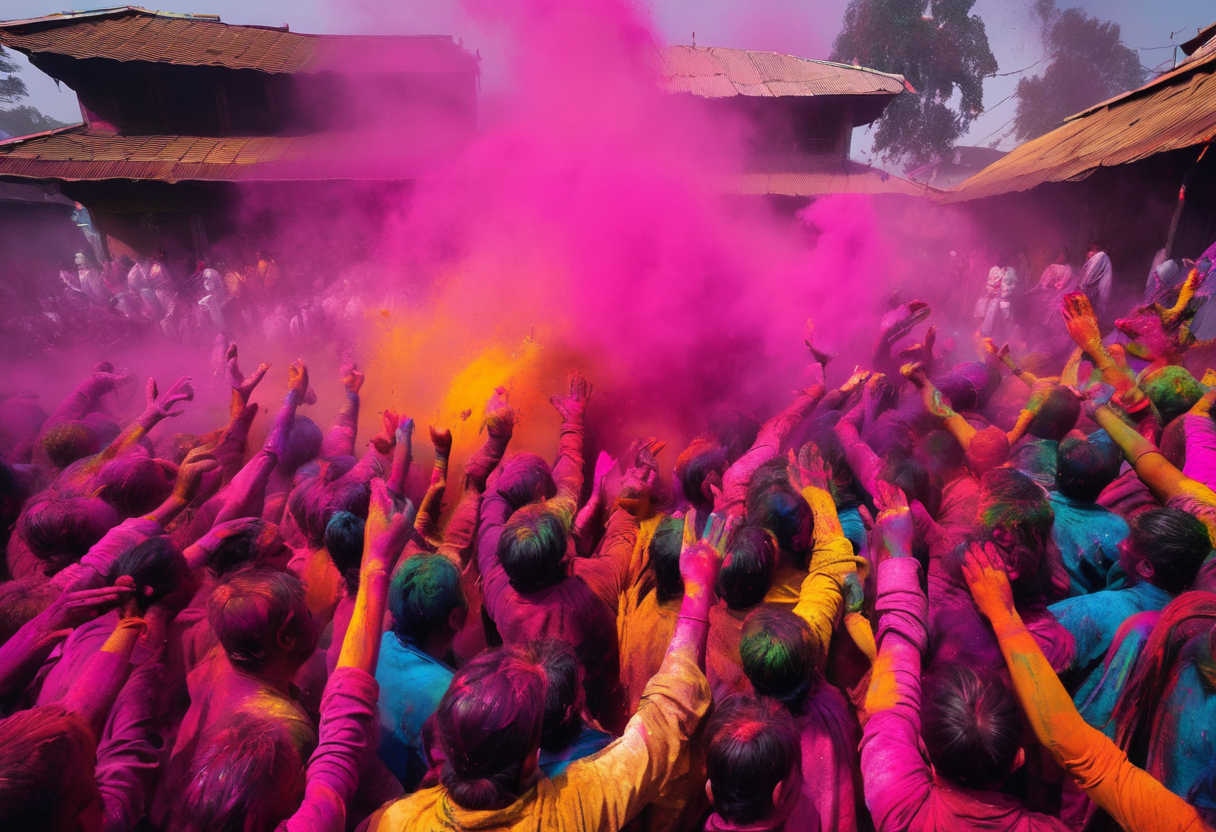
The joyful and colorful festival of Holi is not just celebrated in India, but also has a rich history and significance in the neighboring country of Nepal. The festival, also known as the “Festival of Colors”, is celebrated on the full moon day in the Nepali month of Phalguna (February/March) and marks the arrival of spring. It is a time for people to come together and celebrate the victory of good over evil, light over darkness, and the onset of a new season.
The origins of Holi festival in Nepal can be traced back to Hindu mythology. According to legend, the festival marks the celebration of the defeat of the demon Holika, who was immune to fire. She tried to kill Prahlada, a devotee of Lord Vishnu, by tricking him into sitting on a pyre with her. However, with the grace of the Lord, Prahlada emerged unscathed while Holika burnt to ashes. This symbolizes the triumph of good over evil. Today, the burning of Holika is reenacted through bonfires on the eve of Holi, signifying the destruction of evil forces.
The festival is also associated with another popular legend from Hindu mythology, the love story of Radha and Krishna. The playful and mischievous Krishna is said to have applied color on his beloved Radha’s face, starting the tradition of playing with colors during Holi. This signifies the celebration of love and the power of relationships.
Aside from being a religious and cultural festival, Holi also holds great significance in agriculture. The festival is celebrated at a time when winter crops are harvested and spring crops are sown, signifying the abundance and fertility of the land. It is also a time for people to forgive and forget any past grievances, spread love and happiness, and strengthen relationships.
The Holi festival in Nepal is a beautiful fusion of religion, culture, and tradition. It brings people from all walks of life together, and for a day, all differences are set aside and everyone becomes equal in the vibrant sea of colors. The festival is also celebrated with great enthusiasm by non-Hindu communities, showing how it has become a symbol of unity and inclusivity in the country. So, if you ever get a chance to be in Nepal during the H